









siddharsh
Call us on +91-8826641474
Email: info@siddharsh.com

Social media:

siddharshsiddharsh

Structured Cabling

  • Home
  • Structured Cabling
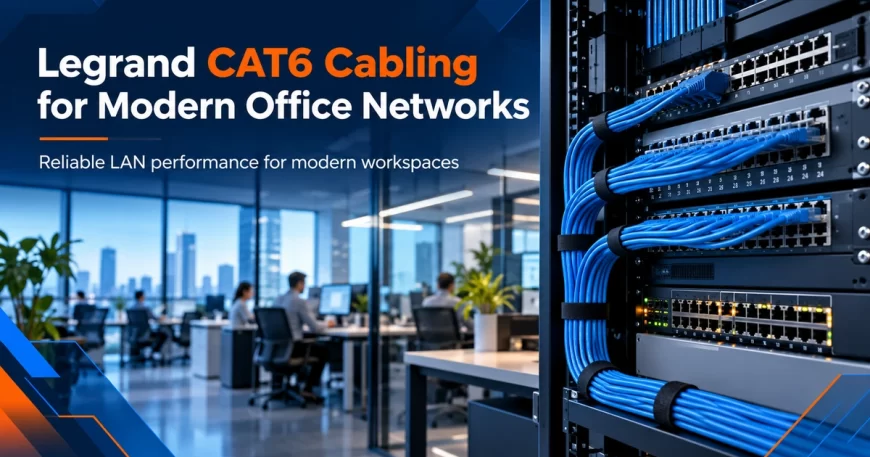
Blue CAT6 ethernet cabling connected to patch panels in a modern office networking rack

Legrand CAT6 Cabling for Modern Offices: Performance, PoE and Installation Decisions

Introduction A new office network often starts with visible equipment: switches, Wi-Fi access points, firewalls and phones. The cabling that joins these systems is less visible but can remain installed through several equipment refresh cycles. Because changing concealed cabling is disruptive, selecting the right structured cabling system has long-term value. Legrand offers enterprise infrastructure and cabling solutions, and Siddharsh works as an authorized Legrand distributor. For consultants, contractors and IT managers, the important decision is not simply whether the invoice says CAT6. It is whether the entire installed channel is designed, sourced and tested for the intended applications. Understand the complete channel The channel can include solid horizontal installation cable, outlets, patch panels and patch cords. Each component influences the performance of the end-to-end link. Mixing component categories or using inconsistent installation practices can undermine the intended rating. A design specification should name the required category, termination method, channel length limitations, outlet configuration and field-test criteria. The goal is a certified, documented installation rather than an assortment of separately purchased items. Where office networks place demands on cabling A modern workplace uses wired endpoints, IP cameras, meeting-room equipment, building controls and numerous wireless access points. These endpoints can be spread across open workspaces, ceilings, meeting rooms and reception areas. Plan outlet positions around actual use and expected moves. For Wi-Fi, coordinate cable runs with the wireless survey and the likely access-point installation position. For surveillance, include camera location, pathway exposure and power needs in the design rather than asking electricians to improvise on site. PoE changes the planning conversation Power over Ethernet reduces the number of separate power outlets needed at many endpoints, but electrical loading still matters. Higher-powered PoE can increase cable-bundle temperature, so engineers should review bundle size, ambient conditions and relevant installation guidance. The cable, patching and active equipment must work together. Evaluate voltage drop and power class requirements where relevant, and keep appropriate separation and routing practices. Never assume a cabling system is suitable for every PoE load solely because the cable is marked CAT6. Avoid installation mistakes that erode performance Excessive pulling, over-tightened ties, poor bend radius, untwisting pairs too far at termination and working too close to sources of interference can create avoidable defects. Keep pathways accessible, follow manufacturer handling limits and provide correct cable support. A clean-looking patch panel does not prove the installation meets the standard. Require test records for every permanent link, investigate failures and ensure identifiers match the final as-built documents. Compare lifecycle cost, not just price per box The real cost of cabling includes installation, termination, testing, disruption from rework and expected replacement life. A lower-cost product that creates inconsistent quality or difficult-to-source accessories may not save money over the project lifecycle. Request clear product specifications, approved component combinations and warranty conditions. Authorized sourcing also makes procurement traceability more straightforward, which is especially relevant to enterprise customers and large multi-site deployments. How Siddharsh supports Legrand requirements Siddharsh works with channel partners and enterprise buyers to coordinate authorized Legrand infrastructure products and project supply. The most productive enquiry includes the number of data points, patch-panel configuration, cable type, installation environment, project schedule and relevant drawings. That helps the distributor map the material requirements more accurately and limit missing accessories during installation. Why work with Siddharsh? Siddharsh System & Solutions Pvt. Ltd. supports resellers, system integrators and enterprise customers through authorized infrastructure distribution, product coordination, pre-sales engagement, logistics and channel support. Share your application requirements or bill of material to discuss the appropriate product families and supply requirements. Product specifications and project suitability should be validated for the intended application. Frequently asked questions Is CAT6 enough for a modern office? CAT6 is suitable for many office applications, but the required speeds, link lengths, PoE needs and upgrade plans should be checked before specifying it. Do CAT6 cable and patch panels need to match? The full channel should be designed with compatible components meeting the chosen category and performance requirements. Where can I buy authorized Legrand infrastructure products? Siddharsh is an authorized Legrand distributor serving channel and enterprise infrastructure requirements. Call to action Planning an infrastructure project? Contact Siddharsh for authorized product sourcing, technical/product coordination and project BOM assistance. Email: info@siddharsh.com  |  Phone: +91 88262 63495. Suggested internal links Legrand: https://siddharsh.com/alliance/brand/legrand Contact: https://siddharsh.com/contact/

Read More
High-speed fiber backbone connecting buildings across an enterprise campus with distribution racks

R&M Fiber Backbone for Enterprise Campuses: Planning High-Speed Connections Between Buildings

Introduction An enterprise campus may include offices, research labs, manufacturing blocks, residential facilities, warehouses and security control rooms. Each building needs a dependable path into the broader network. Fiber-optic backbone infrastructure provides the capacity and reach to connect these locations without treating every building as a standalone island. Yet a reliable fiber network is more than the cable pulled through a duct. Patch panels, splice locations, route diversity, optical loss, documentation and expansion capacity determine how effectively it can be operated. R&M develops copper and fiber connectivity solutions for enterprise networks, and Siddharsh supports customers and integrators as an authorized R&M distribution partner. Start with the campus topology Map the main distribution facility, each building distributor, intermediate pathways and key network rooms. Decide where a star design is appropriate and whether essential buildings need a physically diverse second route. Redundancy is meaningful only when the paths do not share the same vulnerable duct, pit or entrance. The network architecture team should agree on resilience targets before a civil contractor begins trenching. An infrastructure map that includes both fiber connectivity and actual physical routes is more useful than a logical diagram alone. Singlemode or multimode: make a system decision Singlemode and multimode fiber have different optical characteristics and economics. The correct choice depends on link distance, transceiver type, application speed and expected migration path. A short building connection and a kilometer-scale campus link should not automatically receive the same specification. R&M’s backbone guidance recognizes different multimode and singlemode options depending on distance and transmission needs. Use approved equipment interfaces, application tables and an optical budget to validate the choice, rather than selecting cable from a generic purchasing template. Treat connectors and panels as performance components Insertion loss is cumulative. Every connector, adapter, splice and patch cord contributes to the channel budget. Termination quality and cleanliness matter as much as the bulk cable. Select fiber distribution panels based on strand count, access, labeling and expected future patching. In crowded rooms, a high-density panel may preserve space, but it should not compromise the technician’s ability to identify, clean or replace a connection. Correct bend-radius management is essential at every point from the building entrance to the cabinet. Outside-plant and building-entry details matter Campus networks are exposed to construction work, water ingress, temperature changes and maintenance activity. Cable type and protection must match the installation method, whether duct, direct burial or another engineered pathway. Entry points require proper sealing, routing and transition to the indoor environment. The backbone design must also address earthing or bonding where applicable to the installed components. These civil and facilities details are often outside the networking bill of materials, yet they can determine whether the backbone remains dependable. Document and test each link The final deliverable should include route drawings, fiber counts, core allocation tables, connector types, patch-panel identifiers, splice records and test results. Optical loss testing should be performed against an agreed acceptance criterion, with additional diagnostic testing where required by the design. Record both the measured result and the equipment/settings used. A good as-built package lets a future engineer trace a specific fiber without having to open every cabinet along the route. How Siddharsh helps R&M projects For a campus expansion, Siddharsh can work with system integrators to coordinate authorized R&M fiber panels, connectivity accessories and related materials. Sharing the full fiber schedule and termination approach early enables more accurate product mapping and staged supply. The value is not a generic promise of unlimited bandwidth; it is a documented, maintainable backbone designed for the actual network technology and the organization’s future growth. Why work with Siddharsh? Siddharsh System & Solutions Pvt. Ltd. supports resellers, system integrators and enterprise customers through authorized infrastructure distribution, product coordination, pre-sales engagement, logistics and channel support. Share your application requirements or bill of material to discuss the appropriate product families and supply requirements. Product specifications and project suitability should be validated for the intended application. Frequently asked questions Why is fiber used between campus buildings? Optical fiber supports long-distance high-capacity connectivity and is often preferred for building and campus backbone links. Which fiber is better for a campus: singlemode or multimode? Neither is universally better. Distance, supported optics, speed, architecture and lifecycle plans determine the choice. Does Siddharsh distribute R&M fiber connectivity products? Siddharsh is an authorized R&M distributor and supports channel partners with R&M connectivity requirements and supply coordination. Call to action Planning an infrastructure project? Contact Siddharsh for authorized product sourcing, technical/product coordination and project BOM assistance. Email: info@siddharsh.com  |  Phone: +91 88262 63495. Suggested internal links R&M: https://siddharsh.com/r-m-authorized-distributor-in-delhi/ Contact: https://siddharsh.com/contact/

Read More
Panduit structured cabling and connected systems inside a modern smart office building

Panduit Structured Cabling for Smart Buildings: A Practical Infrastructure Guide

Introduction A modern office is no longer a collection of independent technology systems. Wireless networks, video collaboration, access control, surveillance cameras, digital signage and building automation increasingly depend on a common IP foundation. That makes structured cabling a building-design decision rather than an afterthought for the IT team. For developers, workplace consultants and system integrators, the challenge is to make connectivity reliable today without making tomorrow’s changes unnecessarily expensive. Panduit’s structured cabling and infrastructure portfolio offers a way to design that physical layer as a coordinated system. As an authorized Panduit distributor, Siddharsh helps channel partners approach procurement, product selection and installation planning with a clearer infrastructure roadmap. Why connectivity is now part of the building design In a conventional office, the network could be planned mainly around desktop users. In a smart building, many more endpoints compete for pathway space and switch capacity: Wi-Fi access points, IP cameras, access-control panels, sensors, meeting-room equipment and sometimes connected lighting. Their physical locations are widely distributed, often above ceilings and across different floors. The cabling design has to reflect this geography. Early coordination between architects, electrical consultants, IT teams and security integrators can prevent expensive routing compromises after interiors have been completed. Design the complete copper-and-fiber pathway Begin with the campus or building backbone, then map floor distribution rooms and horizontal cabling. Determine which systems need fiber uplinks, which can use copper to endpoints, and where spare capacity should be provided. Specify appropriate patch panels, outlets, pathways and cable management as an integrated design. A structured approach improves labeling, testing and later troubleshooting. It also means that when a floor is reconfigured or a new device is added, engineers have a traceable path rather than a maze of undocumented links. Plan for Power over Ethernet, not just bandwidth Many smart-building devices obtain power through Ethernet cabling. That simplifies deployment, but PoE planning is not only a switch decision. Higher-powered devices can increase heat in large cable bundles, and the cable channel must match the operating conditions. Teams should check equipment power classes, bundle sizes, ambient temperature, pathway conditions and cable specifications. Selection should follow the applicable standards and the manufacturer’s installation instructions. The objective is a channel that performs predictably for both data and power. Give wireless and security systems room to grow Wireless generations change, camera resolution grows and collaboration spaces are redesigned. The physical layer should allow for more ports, additional access points and future moves without major reconstruction. That calls for accessible consolidation points where suitable, appropriately sized racks, spare patching capacity and documented pathways. Designers should also distinguish between operational technology and enterprise IT requirements, including security and network segmentation. Structured cabling supports the physical deployment but does not replace the need for proper logical security design. What Panduit contributes to the architecture Panduit offers components across enterprise connectivity, copper and fiber systems, cable management, cabinets and related network infrastructure. Its breadth helps project teams specify compatible elements rather than assemble a bill of materials from unrelated individual items. For a smart office project, the most useful distributor discussion starts with floor plans, endpoint counts, rack locations and proposed cable routes—not simply an enquiry for boxes of cable. Siddharsh can support channel partners by coordinating those material requirements and the relevant Panduit product families. A practical procurement checklist Before issuing a purchase order, ask for an endpoint schedule by floor, fiber backbone schedule, copper channel design, switch/PoE assumptions, rack elevation, cable routing plan, testing standard, labeling convention and an accessories list. Review installation phases with the contractor: a project may need pathways and bulk cable long before outlet hardware and patch cords. Good distribution planning aligns these stages, reduces missed items and helps keep a technically sound design intact through procurement. Why work with Siddharsh? Siddharsh System & Solutions Pvt. Ltd. supports resellers, system integrators and enterprise customers through authorized infrastructure distribution, product coordination, pre-sales engagement, logistics and channel support. Share your application requirements or bill of material to discuss the appropriate product families and supply requirements. Product specifications and project suitability should be validated for the intended application. Frequently asked questions What is structured cabling in a smart building? It is a planned system of copper and fiber links, outlets, patch panels, racks and pathways connecting building IP devices and workplace networks. Can a smart building use the same cabling for security and Wi-Fi? A coordinated physical cabling infrastructure may serve multiple IP applications, but logical separation, security policies, performance and power requirements must be designed for each system. Why source Panduit through Siddharsh? Siddharsh is an authorized Panduit distributor and can help partners coordinate genuine products, compatible materials, availability and project requirements. Call to action Planning an infrastructure project? Contact Siddharsh for authorized product sourcing, technical/product coordination and project BOM assistance. Email: info@siddharsh.com  |  Phone: +91 88262 63495. Suggested internal links Panduit: https://siddharsh.com/alliance/brand/panduit Contact: https://siddharsh.com/contact/
Read More