










Introduction
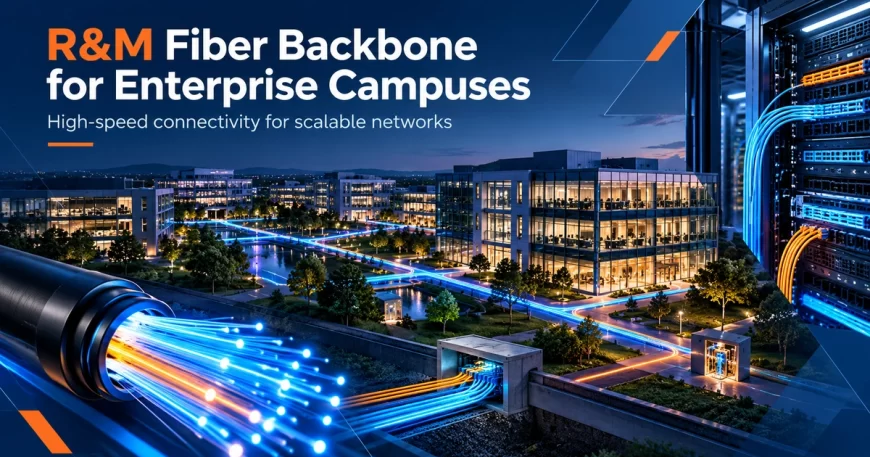
An enterprise campus may include offices, research labs, manufacturing blocks, residential facilities, warehouses and security control rooms. Each building needs a dependable path into the broader network. Fiber-optic backbone infrastructure provides the capacity and reach to connect these locations without treating every building as a standalone island. Yet a reliable fiber network is more than the cable pulled through a duct. Patch panels, splice locations, route diversity, optical loss, documentation and expansion capacity determine how effectively it can be operated. R&M develops copper and fiber connectivity solutions for enterprise networks, and Siddharsh supports customers and integrators as an authorized R&M distribution partner.
Start with the campus topology
Map the main distribution facility, each building distributor, intermediate pathways and key network rooms. Decide where a star design is appropriate and whether essential buildings need a physically diverse second route. Redundancy is meaningful only when the paths do not share the same vulnerable duct, pit or entrance. The network architecture team should agree on resilience targets before a civil contractor begins trenching. An infrastructure map that includes both fiber connectivity and actual physical routes is more useful than a logical diagram alone.
Singlemode or multimode: make a system decision
Singlemode and multimode fiber have different optical characteristics and economics. The correct choice depends on link distance, transceiver type, application speed and expected migration path. A short building connection and a kilometer-scale campus link should not automatically receive the same specification. R&M’s backbone guidance recognizes different multimode and singlemode options depending on distance and transmission needs. Use approved equipment interfaces, application tables and an optical budget to validate the choice, rather than selecting cable from a generic purchasing template.
Treat connectors and panels as performance components
Insertion loss is cumulative. Every connector, adapter, splice and patch cord contributes to the channel budget. Termination quality and cleanliness matter as much as the bulk cable. Select fiber distribution panels based on strand count, access, labeling and expected future patching. In crowded rooms, a high-density panel may preserve space, but it should not compromise the technician’s ability to identify, clean or replace a connection. Correct bend-radius management is essential at every point from the building entrance to the cabinet.
Outside-plant and building-entry details matter
Campus networks are exposed to construction work, water ingress, temperature changes and maintenance activity. Cable type and protection must match the installation method, whether duct, direct burial or another engineered pathway. Entry points require proper sealing, routing and transition to the indoor environment. The backbone design must also address earthing or bonding where applicable to the installed components. These civil and facilities details are often outside the networking bill of materials, yet they can determine whether the backbone remains dependable.
Document and test each link
The final deliverable should include route drawings, fiber counts, core allocation tables, connector types, patch-panel identifiers, splice records and test results. Optical loss testing should be performed against an agreed acceptance criterion, with additional diagnostic testing where required by the design. Record both the measured result and the equipment/settings used. A good as-built package lets a future engineer trace a specific fiber without having to open every cabinet along the route.
How Siddharsh helps R&M projects
For a campus expansion, Siddharsh can work with system integrators to coordinate authorized R&M fiber panels, connectivity accessories and related materials. Sharing the full fiber schedule and termination approach early enables more accurate product mapping and staged supply. The value is not a generic promise of unlimited bandwidth; it is a documented, maintainable backbone designed for the actual network technology and the organization’s future growth.
Why work with Siddharsh?
Siddharsh System & Solutions Pvt. Ltd. supports resellers, system integrators and enterprise customers through authorized infrastructure distribution, product coordination, pre-sales engagement, logistics and channel support. Share your application requirements or bill of material to discuss the appropriate product families and supply requirements. Product specifications and project suitability should be validated for the intended application.
Frequently asked questions
Why is fiber used between campus buildings?
Optical fiber supports long-distance high-capacity connectivity and is often preferred for building and campus backbone links.
Which fiber is better for a campus: singlemode or multimode?
Neither is universally better. Distance, supported optics, speed, architecture and lifecycle plans determine the choice.
Does Siddharsh distribute R&M fiber connectivity products?
Siddharsh is an authorized R&M distributor and supports channel partners with R&M connectivity requirements and supply coordination.
Call to action
Planning an infrastructure project? Contact Siddharsh for authorized product sourcing, technical/product coordination and project BOM assistance. Email: info@siddharsh.com | Phone: +91 88262 63495.
Suggested internal links
R&M: https://siddharsh.com/r-m-authorized-distributor-in-delhi/
Contact: https://siddharsh.com/contact/


